Researchers at the University of Tokyo’s Institute of Industrial Science have developed an organoid that mimics human breathing to measure lung tissue stiffness. Details and outcomes of the research were included in the paper, “Dynamic In Vitro Platform for Mechanical Profiling of Human Pulmonary Aciniform Organoids via Intraluminal Access,” which was published in the journal Biomaterials.

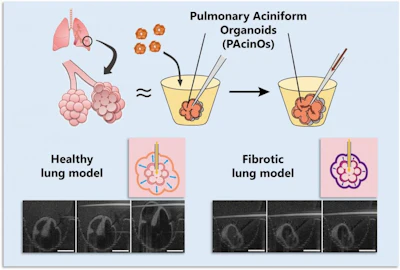
The three-dimensional system, named Pulmonary Aciniform Organoids (PAcinOs), was created from human-induced pluripotent stem cells. It measures quantitative lung expansion — a dynamic mechanical indicator of stiffness, or pulmonary fibrosis, and a key component that previous lung models could not reproduce.
Scientists built the model to simulate the outer region of the lungs — the pulmonary acinus — where gas exchange occurs. They also developed a culture device that allows applied controlled pressure to the internal lumen of the organoids.
PAcinOs works with the DENIRO (Dynamic Exposure and Infusion Response Observer) device to create a structure where researchers use optical coherence tomography to monitor three-dimensional volume changes within the organoid and compare them to variations in pressure. This process provides quantified lung compliance, which helps determine mechanical changes associated with lung disease.
For example, when researchers introduced bleomycin (a compound that can induce pulmonary fibrosis in an experimental environment) to the organoids, they observed increased pressure and reduced expansion, which indicates decreased lung compliance.
The scientific advancement may provide an improved method for studying pulmonary diseases, such as fibrosis, that are characterized by stiffened lung tissue. The researchers also suggested it could assist in testing potential pharmacologic treatments.