Research has revealed that analyzing proteins in a simple blood test could improve earlier and more informed treatment decisions for patients who have non-small cell lung cancer (NSCLC). The paper, “Dissecting Non-Small Cell Lung Cancer (Nsclc) With Blood Proteomics — From Surgical to Immunotherapeutic Responses,” was published in npj Precision Oncology.

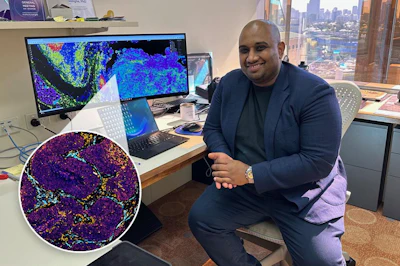
Arutha Kulasinghe, PhD, associate professor at the University of Queensland’s Frazer Institute in Brisbane, Australia, led the research team and said the discovery could help predict how patients react to therapy and improve outcomes.
“This is a step towards truly personalized lung cancer care,” said Dr. Kulasinghe in a university news release. “At the moment, clinicians often have to make treatment decisions without a clear picture of how a patient will respond. What we’re showing is that information already exists in the blood.”
In the study, researchers analyzed blood samples of patients with NSCLC at Princess Alexandra Hospital. They measured proteins and tracked how protein levels changed before and after surgery and immunotherapy. They employed statistical modeling to identify signals related to treatment response and disease progression, then validated their findings using an independent testing platform.
Investigator Aaron Kilgallon, PhD, from the Queensland Spatial Biology Centre, reported significant clinical implications.
“Blood-based monitoring would be far less invasive than repeat biopsies and could give us earlier warning of recurrence. That’s a meaningful shift for patients,” Dr. Kilgallon said.
Further research is required before putting the approach into clinical practice. The team said it’s also evaluating if a blood test could improve therapeutic decision-making in other types of cancer.

“We want to use a patient’s own biology to guide treatment decisions at diagnosis,” Dr. Kulasinghe said. “If we can tell from a blood sample who is most likely to relapse or who will respond to immunotherapy, we can match patients to the right treatment sooner.”