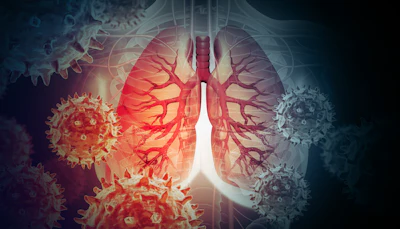
A paper published in the journal, Cell, suggests severe respiratory infections, such as COVID-19, pneumonia or influenza, may increase a person’s risk to develop lung cancer later in life. Researchers from the University of Virgina (UVA) School of Medicine, UVA Health’s Beirne B. Carter Center for Immunology Research and the UVA Comprehensive Cancer Center, who led the study, also found that vaccines appear to protect the lungs from conditions that can cause these harmful effects.

In their paper, “Respiratory Viral Infections Prime Accelerated Lung Cancer Growth,” the authors noted severe respiratory viruses can alter immune cells in the lungs to promote the growth of tumors months or years afterward.
“A bad case of COVID or flu can leave the lungs in a long-lasting inflamed state that makes it easier for cancer to take hold later,” said Jie Sun, PhD, in a news release. Dr. Sun is co-director of UVA’s Carter Center and a member of UVA’s division of infectious diseases and international health. “The encouraging news is that vaccination largely prevents those harmful changes for cancer growth in the lungs.”
Dr. Sun and team examined the effects of serious respiratory infections in human patients and laboratory mice. In both experiments, those with severe cases were more likely to develop as well as die from lung cancer. The diagnostic rate was highest (1.24-fold) for individuals who had been hospitalized with COVID-19.
From the mouse experiment, researchers identified the source of the increased risk. Respiratory infections, especially those that are severe, can lead to immune cell changes such as abnormally functioning neutrophils. The alterations weaken lung tissue protection and contribute to ongoing inflammation linked to tumor growth. The team also noticed significant changes in epithelial cells.

These biological modifications were not present in individuals with mild respiratory infections, the authors noted, purporting that vaccination (which eases symptoms) can prevent the increased risk.
Based on their findings, the researchers recommend that physicians monitor patients who have had severe viruses to be able to detect lung cancer early when treatment is most effective.
“These findings have important immediate implications for how we monitor patients after severe respiratory viral infection,” said UVA physician-scientist Jeffrey Sturek, MD, PhD.
“Together, these findings establish a causal link between prior viral pneumonia and lung tumorigenesis, underscoring the need for enhanced surveillance and targeted interventions to reduce post-COVID cancer risk,” the authors wrote.