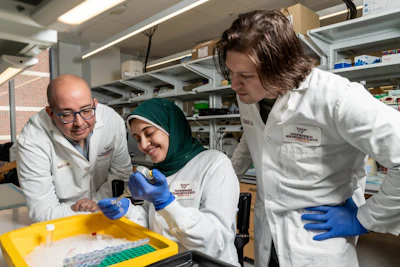
A research team from Virginia Tech has developed an experimental treatment that could be groundbreaking for patients who have idiopathic pulmonary fibrosis (IPF). The therapy, which concurrently inhibits two proteins, ID1 and ID3, has shown to reduce and even reverse lung scarring as well as improve lung function.

Results of the preclinical study are detailed in the paper, “Simultaneous Inhibition of ID1 and ID3 Mitigates Fibroblast Activation via Cell Cycle and MEK/ERK Pathways in Pulmonary Fibrosis,” published in Theranostics.
“This work identifies ID1 and ID3 as important drivers of fibrosis and provides a strong foundation for developing new therapeutic approaches, including drug development and targeted delivery strategies,” said senior author Yassine Sassi, PhD, in a university news release. Dr. Sassi is an assistant professor with the Fralin Biomedical Research Institute at the Virginia Tech Carilion School of Medicine and an assistant professor in the department of biomedical sciences and pathobiology at Virginia-Maryland College of Veterinary Medicine.
Researchers in the Sassi lab examined experimental mice models and analysis of human lung tissue and cells from patients with IPF. They observed elevated levels of ID1 and ID3 in damaged lung fibroblasts. When the two proteins were blocked, fibroblast activation reduced significantly, thereby restricting the development of pulmonary fibrosis, slowing disease progression and improving lung function.
“By targeting these pathways, we can directly interrupt the cellular processes that drive fibrosis,” Dr. Sassi said.
According to the authors, the benefits of the targeted delivery approach were equal to or greater than those of existing antifibrotic drugs. “Targeting ID1/ID3 represents a potential novel therapeutic strategy for IPF,” they wrote.