Researchers from Kyoto University in Japan have identified a naturally occurring signaling molecule called C-type natriuretic peptide (CNP) that reduces the severity of pulmonary arterial hypertension (PAH) in mice. Their paper, “Endothelial C-Type Natriuretic Peptide/Guanylyl Cyclase-B Signaling Prevents Pulmonary Arterial Hypertension,” was published in Nature Communications.

CNP is a hormone produced naturally by endothelial cells. According to the paper’s authors, prior research has recognized its importance in blood vessel health and blood pressure regulation. However, it’s role in PAH is undefined, and studies of pulmonary hypertension in rat models had inconsistent results, they said.
First author Hiromu Yanagisawa, MD, along with his colleagues at Kyoto University employed two mouse models of PAH to perform experiments. One model used a chemical called monocrotaline pyrrole, and the other used chronic low level oxygen exposure. Concurrently, the researchers analyzed human cell models and lung tissue samples from individuals with PAH.
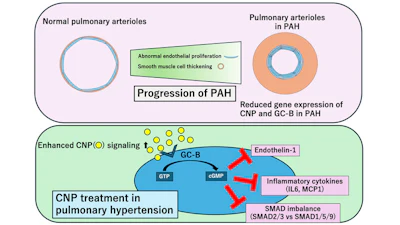
Across the study, the researchers observed decreased levels of CNP in PAH as well as decreased levels of guanylyl cyclase-B (GC-B) — the main molecular receptor for CNP — which they said suggests an overall reduction in activity of the CNP signaling pathway.
To assess this further, the team engineered mice to stop producing CNP and GC-B, which caused more severe PAH and increased activity in the inflammatory molecules. Mice that lacked GC-B in vascular smooth muscle did not experience the same outcomes. The authors noted this suggests the critical function of the GC-B receptor in endothelial cells.

“These results indicate that a decrease in endothelial CNP/GC-B signaling plays an important role in the progression of PAH,” they wrote.
Researchers also found that administering CNP could prevent the development of PAH in mice that were unaltered or lacked GC-B in vascular smooth muscle. However, the CNP treatment did not have the same effect on mice lacking GC-B in endothelial cells.
“This study highlights the important role of CNP/GC-B signaling in the pathogenesis of PAH and suggests that modulation of the pathway may provide a potential therapeutic approach for PAH in humans,” wrote the study’s researchers.
The scientists performed an additional experiment to evaluate the possible benefits of adding CNP therapy to PAH treatments in mice with PAH. Individually, each therapy reduced pressure in the heart’s right ventricle and lessened PAH-associated enlargement of the right ventricle. These benefits were greater when scientists combined CNP with macitentan or sotatercept.
According to the authors, results of the study suggest CNP signaling through the GC-B receptor on endothelial cells may prevent the development of PAH or reduce disease severity, though additional research should be performed.
“This study builds on many years of research in our laboratory, so it was especially meaningful for us to uncover a new protective role for endothelial CNP/GC-B signaling in PAH,” said Dr. Yanagisawa in a university news release. “We hope this will pave the way toward new treatment strategies for patients with PAH.”