Hypnosis could significantly improve patients’ tolerance to masks that help them breathe when they are suffering from acute respiratory failure. That’s according to a pilot study that was recently presented at the European Emergency Medical Congress, sponsored by the European Society for Emergency Medicine (EUSEM).

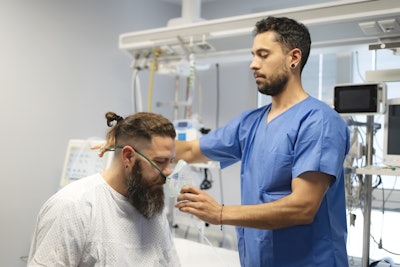
Patients who come to hospitals with breathing problems are often treated with noninvasive ventilation (NIV) in the form of masks connected to machines that increase the amount of oxygen in their blood and lower carbon dioxide levels. But some patients cannot tolerate these masks and often have to be sedated or treated with anti-anxiety medicine.
In a news release, Tobi Hamza, MD, a resident emergency medicine doctor at the Mohammed V Military Teaching Hospital in Rabat, Morocco, said the study was conducted in response to seeing this anxiety in his patients on a daily basis. Tobi Hamza, MD
“Given the increasing interest in nonpharmacological techniques to improve patient comfort and compliance, we wanted to explore whether medical hypnosis could improve NIV tolerance and outcomes,” he said.
Between December 2023 and May 2024, Dr. Hamza and his colleagues recruited 20 patients who came into the hospital’s emergency department with acute respiratory distress to join the pilot study. They randomized the participants into two groups: 10 patients received the standard NIV care and anti-anxiety medication, if needed, and 10 received a hypnosis session and NIV.
“The hypnosis session consisted of a calming induction phase using voice guidance, breathing synchronization and visual imagery, a deepening phase to reduce anxiety and enhance dissociation from physical discomfort, and a therapeutic suggestion phase aiming to promote feelings of safety [and] trust in the treatment and cooperation with the mask,” Dr. Hamza said. “A doctor trained in medical hypnosis conducted all the sessions.”

The researchers assessed how well the patients tolerated the masks using a comfort score with a scale from zero to 10. They assessed changes in oxygen, carbon dioxide and acidity levels (pH) in the arterial blood at one and four hours and noted any requirement for sedation and anti-anxiety medication and whether NIV had to be discontinued.
“Our most significant result was a substantial improvement in NIV tolerance in the hypnosis group,” Dr. Hamza said. “Eight out of 10 patients (80%) in the hypnosis group successfully completed noninvasive ventilation sessions without requiring sedation or switching to invasive ventilation, compared to only five out of 10, or 50%, in the control group.”
Dr. Hamza said they also observed a reduction in agitation and respiratory distress scores, shorter duration of emergency room stay and reduced need for anti-anxiety medication.
“After four hours, we saw greater reductions in carbon dioxide in the blood and the acidity levels returned to normal,” he added. “We were positively surprised by the magnitude of the difference. It confirmed that hypnosis could be a powerful complementary tool in emergency respiratory care.”

Patients in the hypnosis group reported a comfort score of 7.5 out of 10, compared to 4.3 in the control group.
Felix Lorang, MD, head of the emergency department at SRH Zentralklinikum Suhl in Thuringia, Germany, and member of the EUSEM abstract selection committee, praised the study, adding that it “deserves further investigation in larger groups of patients.”