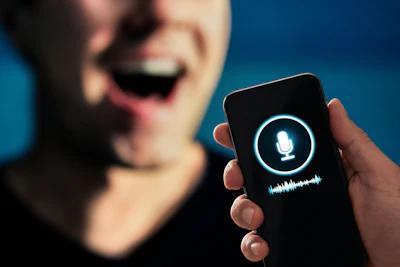
Voice changes recorded with a smartphone app can be used to signal flare-ups in symptoms for patients with COPD or asthma. That’s according to the paper, “Voice as Biomarker for Early Exacerbation Detection in Asthma and COPD: The TACTICAS Study,” published in ERJ Open Research.

The study examined a cohort of 73 participants — 38 with COPD and 35 with asthma. A daily voice sample was collected at home on their own mobile devices for three months. At the same time, the duration of an exacerbation, including onset, peak and recovery, was captured using the EXACT questionnaire.
The researchers analyzed changes in 39 speech features during the onset, peak and recovery. Voice changes were detected at exacerbation onset, where 13 voice features had a significant fixed effect. These features included a decrease in the duration of sustained vowels and an increase in shimmer (the irregularity of vocal fold vibrations) and noise-to-harmonics ration. Combined, these indicated a deterioration of overall voice quality during an exacerbation.
Lead researcher Sami Simons, MD, assistant professor at Maastricht University and consultant physician at Maastricht University Medical Center in the Netherlands, said the study also showed these measures improved as the flare-ups subsided.
“We found that voice significantly changes during an exacerbation of asthma or COPD, and that this occurs as early as the first day that symptoms deteriorate,” Dr. Simons said in a press release. “As the airways constrict during an exacerbation, the air that passes the vocal folds is limited. This weakens the normal vibration of the vocal folds, making it harder to keep the voice steady. As a result, the voice of someone with an exacerbation sounds breathier and rough.”

The TACTICAS app (Telemonitoring for Asthma and COPD Through voICe AnalysiS) was co-designed with patients and a startup called Zana Technologies. The researchers used the information gained to develop machine learning algorithms that can detect exacerbations based on voice changes as early as three days before symptoms show. They are now testing this technology in two new studies: the VOCAL study in Brazil and the SPEAK study in the Netherlands.
They have also created a website, called Speak to COPD, to provide more information about the technology and studies.
Dr. Simons said that in the future it may be possible to use a daily voice check to monitor for the earliest sign of a flare-up. This means treatment could be given as soon as possible.
“People are often at home or work when exacerbations start and they usually need to get into a hospital or clinic for testing,” Dr. Simons said. “This means there’s a delay and the patient’s suffering is prolonged. Early on in my career, I was told that the voice is different during flare-ups. Now, the rise of artificial intelligence means it’s possible to perform a sophisticated analysis to find patterns in audio recordings. Capturing voice via a mobile phone is the next logical step to detect deteriorations in asthma or COPD at home and on time.”