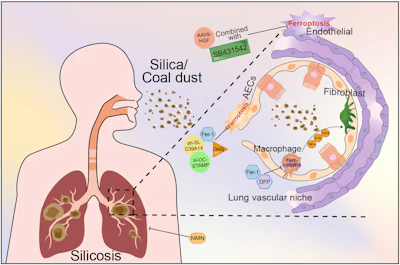
A review published in the journal Med Research evaluates the possibility of targeting ferroptosis to treat patients with pneumoconiosis — a progressive occupational lung disease caused by inhaling dust-related particles.
Pneumoconiosis is a global health burden that impacts people who work with mineral dusts, like coal, silica and asbestos. Ferroptosis is a structured cell death process that is characterized by excessive build-up of iron and lipid peroxides. Affected cells fail to engage their antioxidant defense systems, which are regulated primarily by the GPX4 enzyme.

In the study, “Ferroptosis in Pneumoconiosis: From Molecular and Cellular Mechanisms to Therapeutic Strategies,” researchers evaluated emerging therapies that target ferroptosis — known to be the key driver of pneumoconiosis.
The team’s preclinical findings showed that certain ferroptosis inhibitors can improve lung fibrosis and slow disease progression in animal models. For example, Ferrostatin-1 can trap free radicals and prevent chain reactions, while Dihydroquercetin helps reduce iron accumulation and triggers protective pathways.
The authors said the study serves as a theoretical framework for future research and supports refining a precision medicine approach that could be combined with existing treatments to improve patient outcomes.