A project at the Southwest Research Institute (SwRI) is developing ways to improve inhalers for people who can’t inhale deeply.
According to a press release, the multidisciplinary team of researchers is working to build a more effective inhaler for people who are unable to manage the strong, deep breaths that are crucial for maximum benefit.

“For children and people with conditions like COPD, some inhalers don’t reliably get enough medicine into the lungs,” said project leader Raouf Tajik, PhD, a research engineer in SwRI’s mechanical engineering division. “A lot of the medication remains in the mouth and throat or within the device instead of reaching deep in the airways. That wastes medicine and delivers an uncertain dosage.”
The research team is using a combination of computational fluid dynamics (CFD), particle science and pharmaceutical science to create and test new inhaler designs that reduce deposition in the mouth and throat, increase penetration of particles in the lungs and allow weak inhalation to pull enough medicine into the lungs.
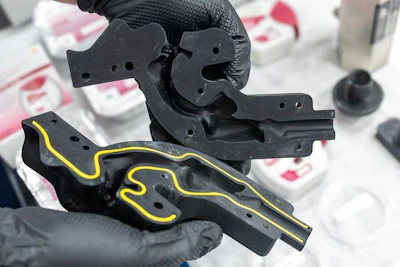
Dr. Tajik led the CFD modeling, which simulated how air flows through a child’s airway and how particles from the inhaler deliver medication to the mouth, throat and deeper airways. From there, SwRI engineer Imad Khalek, PhD, who oversees the Particle Science and Technology facility, used a breathing simulator machine connected to a 3D-printed model of the airway to characterize the medicinal particles and pathways.
“We tested both dry and wet surface versions of the airway to mimic real, moist human airways,” Dr. Khalek said. “This helped us to see that moisture changes how deeply inhaled particles penetrate.”

Staff in SwRI’s chemistry and chemical engineering division then acted as subject matter experts for the particles and materials used in the inhaler. Dry powder inhalers use a larger carrier particle along with a smaller drug particle, the researchers said. When the particles are too small, they tend to be exhaled by the user; when they are too big, they often can’t penetrate deep enough into the lungs.
“The variability with inhalers can be significant and potentially dangerous. Overdosing can lead to adverse effects while underdosing can make treatments ineffective,” said SwRI scientist James Oxcley, PhD, leader of the chemical engineering aspects of the project. “An improved design could deliver potentially more potent drugs that currently aren’t suitable for inhalers because of that variability.”
The work on the redesigned inhalers is ongoing, SwRI reported.