A research team at Oklahoma State University’s College of Engineering, Architecture and Technology has developed a computational fluid particle dynamics and AI-driven framework that is designed to help inhaled medications reach the airways of patients with COPD more effectively and more uniformly.

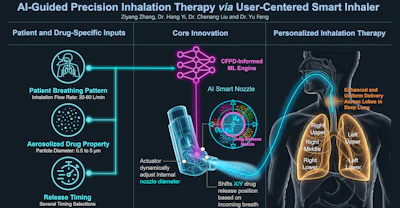
According to a university news release, the framework combines physics-based simulations of airflow and drug particle dynamics in the lungs with machine learning (ML). This combination will lay the groundwork for a new generation of user-centered smart inhalers that can adapt to individual patients.
“An easy way to think about this research is like GPS navigation for drug aerosol particles that travel inside the complex road maps in the lung airways,” said Yu Feng, PhD, who is part of the research team and an associate professor in OSU’s School of Chemical Engineering. “A conventional inhaler releases the medication broadly, somewhat like sending many delivery trucks (i.e., drug particles) into a big city (i.e., designated lung sites) without specific routes. Some particles could reach the intended neighborhoods, but others may stop too early or even end up in the wrong places.”
The team’s research uses computational fluid particle dynamics (CFPD) combined with machine learning to identify the best route for inhaled drug particles so that more of the medicine can reach the smaller airways where and how different breathing patterns, airway geometries, particle sizes and release conditions affect delivery.
A key advantage to this approach is that it allows researchers to generate data that would be difficult — if not impossible — to collect through traditional laboratory or human studies, said Dr. Feng.

“CFPD can track millions of particles throughout a subject-specific airway model and identify how changes in release position, release timing, inhalation flow rate and particle size influence deposition in different lung regions,” he said.
The data generated by CFPD then becomes the foundation for the machine learning portion of the platform.
“Machine learning can learn from these high-fidelity CFPD datasets and rapidly predict improved inhaler settings for new patient-specific and drug-specific conditions,” Dr. Feng said. “In simple terms, CFPD acts like a high-resolution virtual laboratory, and ML turns the knowledge generated in that laboratory into a fast, decision-making tool.”
The ML models developed by the team were tested using more than 100 detailed computer simulations that showed how air and medicine particles move through the lungs. Most of these were used to train the models, while the rest were used to evaluate prediction accuracy.
According to the researchers, validation studies showed that this approach significantly improved the uniformity of drug delivery and reduced off-target deposition in the mouth, throat and upper airways when compared with conventional full-mouth release strategies. While most currently available smart inhalers focus on tracking usage or reminding patients to take medication, the OSU team’s proposed smart inhaler would optimize medication delivery based on inputs specific to the patient and the drug.

“This is not just telling patients how they used an inhaler,” Dr. Feng said. “It’s about using engineering and AI to help the inhaler work better for them.”