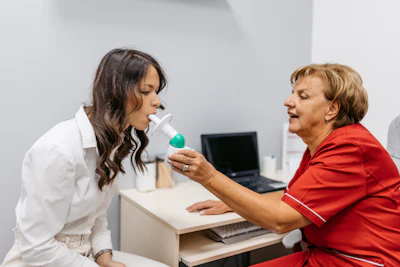
The Global Initiative for Chronic Obstructive Lung Disease (GOLD) and the Global Lung Function Initiative (GLI) have issued a joint statement on the use and interpretation of spirometry for the diagnosis of COPD.
The “Joint Statement From GOLD/GLI Regarding the Use of Spirometry to Define Airflow Obstruction and Diagnose COPD,” was accepted for publication by the European Respiratory Journal, authored by Halpin DMG, Stanojevic S, McCormack MC, et al.

Prior to this joint statement, each organization had differing recommendations on what the threshold should be for defining airflow obstruction. GOLD recommended a fixed ratio defined as a post-bronchodilator FEV1/FEV < 0.7 to identify COPD-related airflow obstruction, while GLI recommended using a lower limit of normal for the FEV1/FEV ratio.
The joint statement emphasized that neither threshold was intrinsically right or wrong, and they both “evolved to solve different problems” with “fundamentally different goals.”
“GLI and GOLD agree that the differences in recommendations about thresholds of ‘abnormality’ are outweighed by shared concerns about the underuse of spirometry,” according to the statement. “The false dichotomy in applying thresholds and comparing these two approaches ignores the clinical context.”
The two organizations agreed that the race-based reference values previously used in the classification of spirometry results can lead to the underestimation of the severity of airflow obstruction, normalize disparities in lung health and should not be used. To address this issue, they agreed that race-neutral equations published by GLI in 2022 are the most appropriate and should be used as a standard. The statement also acknowledged that further work is needed in this area to establish a more permanent solution.

The organizations also agreed that spirometry alone is not sufficient to make a diagnosis of COPD. “A clinical diagnosis of COPD must be based on interpreting a patient’s exposures, medical history and symptoms together with a physiological measure of airflow obstruction,” according to the paper.
In addition, the statement said spirometry results “can be affected by measurement errors and biological variability, which contribute to uncertainty when interpreting results.”
Professor David Halpin, MA, DPhil, MB, BS, member of the GOLD Board and co-athor of the statement, praised the two organizations for coming together for the greater good of advancing the testing and treatment of COPD.
“Working with GLI to agree how spirometry should be interpreted to confirm the diagnosis is an important step forward in addressing the huge levels of underdiagnosis of COPD globally,” he said. “Both organizations are clear that more spirometry tests need to be performed, and we hope that making its interpretation simple will help with this.”