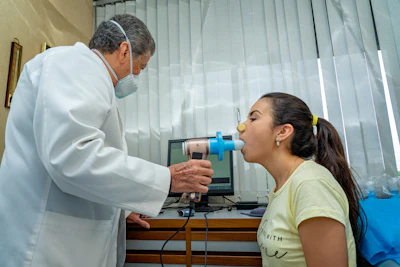
Measuring lung function earlier in life would help identify people at risk for developing COPD, thus allowing for more timely interventions.
That’s according to a study, “Low Lung Function in Middle-Aged Smokers Impacts Health Status, Morbidities, and Mortality: An Observational Analysis of the Lovelace Smokers Cohort,” published in Chronic Obstructive Pulmonary Diseases: Journal of the COPD Foundation.

Spirometry is the standard measuring tool for lung function but is not routinely performed on younger people. In the study, researchers examined how lung function may be connected to comorbidities and health-related quality of life. They also looked at whether lung function in middle-aged ever smokers was predictive of long-term mortality risk.
The study used data from the Lovelace Smokers’ Cohort of 830 current and ever smokers between the ages of 40 and 60 who did not have baseline airway obstruction. Of those, 87 participants were included in a 17-year follow-up cohort. Participants were classified as either low or high lung function. The Lovelace Smokers’ Cohort is a longitudinal study of people aged 40 to 75 with at least a 10-pack-per-year smoking history in the Albuquerque, New Mexico region.
The study authors found that participants with low lung function had an increased all-cause mortality risk and worsened health-related quality of life in both the overall and 17-year follow-up groups, regardless of smoking history.
“Spirometry is a simple way health care providers can identify people with low lung function earlier in life, especially for those with a smoker history,” Yohannes Tesfaigzi, PhD, a researcher with Mass General Hospital, said in a news release. “Identifying individuals at risk would allow health care providers to focus sooner on interventions, such as smoking cessation programs, that we know can slow lung function decline and make a positive impact on people’s long-term health.”